Robots4Inclusion: International Study Reveals Encouraging Long-Term Results for Students’ Sense of Belonging
 Robots4Inclusion: International Study Reveals Encouraging Long-Term Results for Students’ Sense of Belonging
Robots4Inclusion results
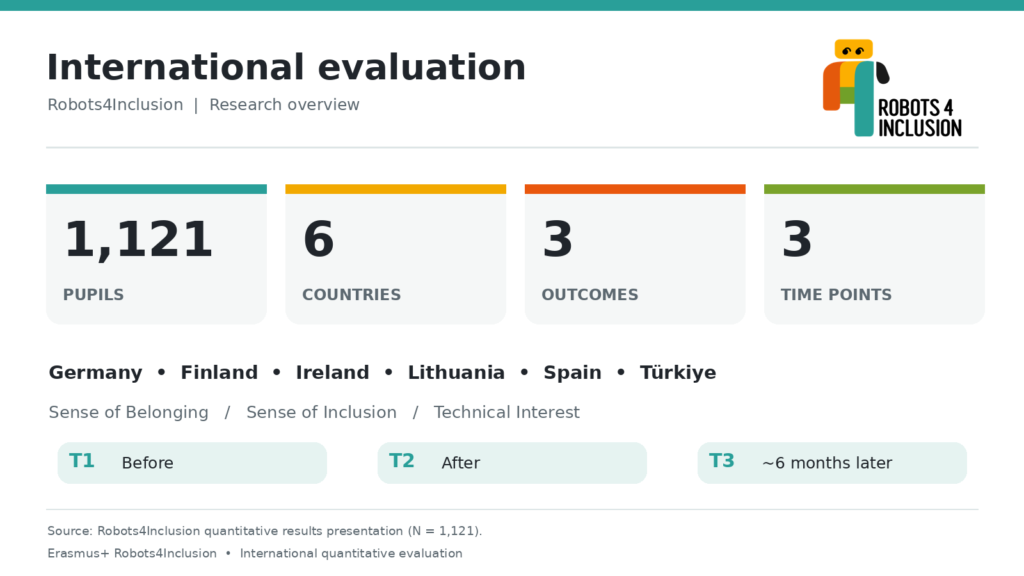
An international evaluation involving 1,121 primary school pupils across six European countries and Türkiye provides new insights into the potential of educational robotics and social-emotional learning to support inclusive education.
The Erasmus+ Robots4Inclusion project has examined how classroom activities combining educational robotics, cooperation and social-emotional learning may influence children’s sense of belonging, sense of inclusion and interest in technology.
The quantitative study brought together data from six participating countries: Germany, Finland, Ireland, Lithuania, Spain and Türkiye.
Evaluating Inclusion Through Educational Robotics
The project implemented classroom activities designed to encourage collaboration, emotional awareness and positive peer relationships.
The evaluation focused on three key indicators:
- Sense of Belonging: children’s feelings of connection to their classmates and school community.
- Sense of Inclusion: pupils’ perceptions of inclusion and participation.
- Technical Interest: children’s interest in technology-related activities.
The research included assessments before the intervention (T1), immediately afterwards (T2) and approximately six months later (T3).
This approach enabled researchers to examine both immediate and longer-term outcomes.
What Did the International Results Reveal?
The findings showed that positive changes were not necessarily immediate.
Immediately after the intervention, the evaluation did not identify strong or consistent improvements across the three indicators.
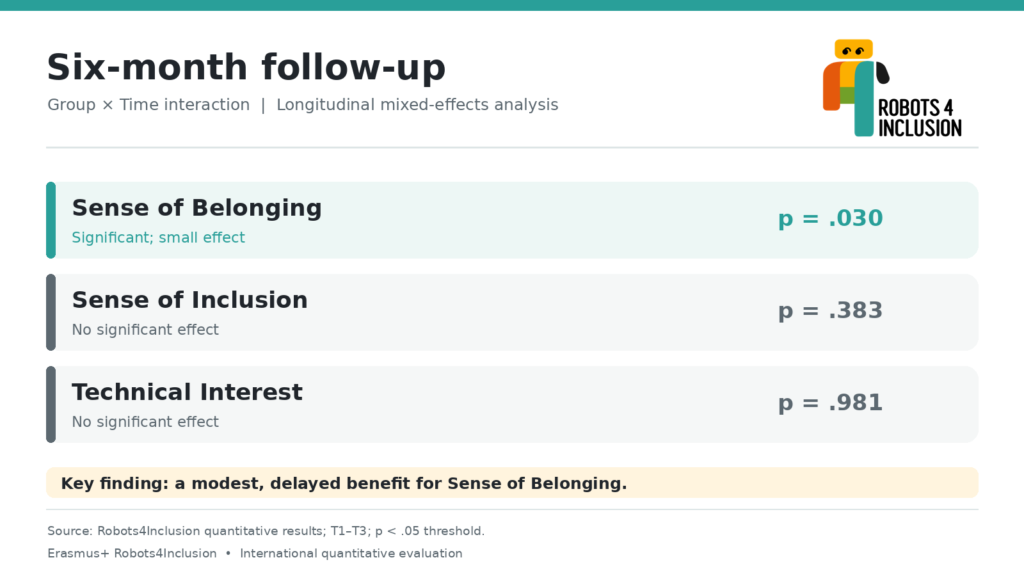
However, the six-month follow-up revealed a more encouraging pattern.
The clearest finding concerned Sense of Belonging.
Compared with the control group, pupils who participated in the intervention showed a significantly more favourable change over time.
This result was supported by different statistical approaches, including longitudinal mixed-effects analysis (p = .030).
Although the effect was small, the findings suggest that the programme may have contributed to gradual improvements in children’s feelings of connection to their classroom community.
Why Might Belonging Take Time to Develop?
Positive peer relationships and inclusive classroom environments are not necessarily established immediately after an educational activity.
They develop through repeated interactions, cooperation and shared experiences.
The findings suggest that activities encouraging children to work together, recognise emotions and build relationships may have benefits that become more visible over time.
This highlights the importance of evaluating social-emotional learning interventions beyond the immediate classroom experience.
What About Inclusion and Interest in Technology?
The results for Sense of Inclusion and Technical Interest were less consistent.
Although some statistical comparisons identified differences, the overall analyses did not provide robust evidence of sustained improvements in these dimensions.
The research therefore points to a more specific potential benefit in Sense of Belonging rather than demonstrating improvements across every outcome measured.
Research That Supports Educational Practice
The international Robots4Inclusion results evaluation offers valuable evidence for teachers, schools and educational organisations interested in combining robotics with social-emotional learning.
It also demonstrates why long-term assessment is important when evaluating educational interventions focused on classroom relationships and inclusion.
For M&M Profuture Training, participation in Robots4Inclusion reflects our commitment to innovative, evidence-based and inclusive educational practices.
The project findings will help inform future teaching resources, professional development activities and approaches to collaborative learning.
Discover more about Robots4Inclusion and its educational resources:
Robots4Inclusion is co-funded by the European Union through the Erasmus+ Programme.