
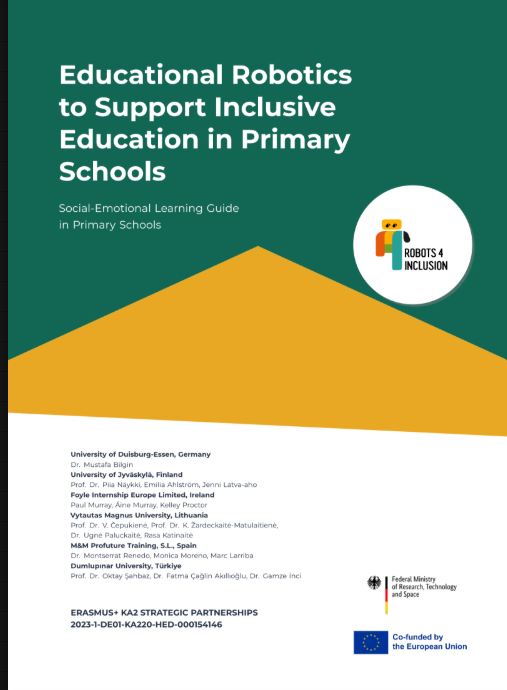
Robots4Inclusion SEL Guide: 16 Practical Activities for Inclusive Primary Education
The Erasmus+ Robots4Inclusion project has developed a Social-Emotional Learning (SEL) Guide to help primary school teachers promote empathy, communication, collaboration and a stronger sense of belonging in the classroom.
The Social-Emotional Learning Guide in Primary Schools provides educational professionals with practical strategies, theoretical foundations and classroom activities designed to strengthen children’s social and emotional competencies.
Developed through European cooperation, the guide focuses particularly on pupils aged 8–9 and supports inclusive teaching approaches that respond to different learning needs.
What Does the Robots4Inclusion SEL Guide Offer?
The guide combines educational research with practical recommendations that teachers can integrate into everyday classroom activities.
It is organised into four main sections:
- Understanding Social-Emotional Learning: key concepts, theoretical foundations and the importance of SEL in child development.
- Inclusive Teaching Strategies: approaches to building positive classroom relationships, encouraging prosocial behaviour and integrating SEL into lesson plans.
- SEL and Educational Technology: guidance on using digital tools and educational robotics to support social-emotional development and inclusion.
- Practical Classroom Activities: 16 activities addressing belonging, empathy, communication and collaboration.
The resource is designed to help teachers move from understanding SEL concepts to applying them in real classroom situations.
16 Practical Activities to Develop Social-Emotional Skills
One of the guide’s key features is its collection of 16 classroom activities, organised around four essential competencies.
Sense of belonging and inclusion: activities such as Gratitude Circle and School of Fish encourage positive relationships and participation.
Empathy and perspective-taking: exercises including Friendship Sandwich help pupils understand emotions, friendships and constructive ways to resolve disagreements.
Communication and interpersonal skills: activities such as Listening Actively – An Introduction help children practise listening, expressing feelings and communicating respectfully.
Collaboration and teamwork: activities including The Quest for the Magical Garden combine cooperative learning, problem-solving and educational robotics.
Each activity includes practical information such as objectives, expected learning outcomes, suggested duration and required materials, making it easier for teachers to adapt the exercises to their classrooms.
Connecting Educational Robotics with Social-Emotional Learning
Robots4Inclusion explores how educational robotics can support inclusive education by combining technological learning with social interaction.
The SEL Guide introduces strategies for integrating robotics and other technological tools into activities that encourage communication, teamwork and active participation.
It also provides recommendations for adapting technology-based activities to pupils’ individual needs, helping teachers create accessible and supportive learning experiences.
A European Resource Supporting Inclusive Education
The guide has been developed through the collaboration of the Robots4Inclusion project partners from Germany, Finland, Ireland, Lithuania, Spain and Türkiye.
M&M Profuture Training participates in this European partnership, contributing to the development and dissemination of educational resources that promote innovative and inclusive teaching practices.
Published as an Open Educational Resource under the Creative Commons CC BY-SA 4.0 licence, the guide can be shared and adapted by educational professionals with appropriate attribution.
Through resources such as this SEL Guide, Robots4Inclusion aims to support teachers in creating classrooms where children can develop both technological and social-emotional skills.
Discover more about the Robots4Inclusion project and its educational resources:
Robots4Inclusion – Educational Robotics to Support Inclusive Education in Primary Schools.
Erasmus+ Project: 2023-1-DE01-KA220-HED-000154146. Co-funded by the European Union.